
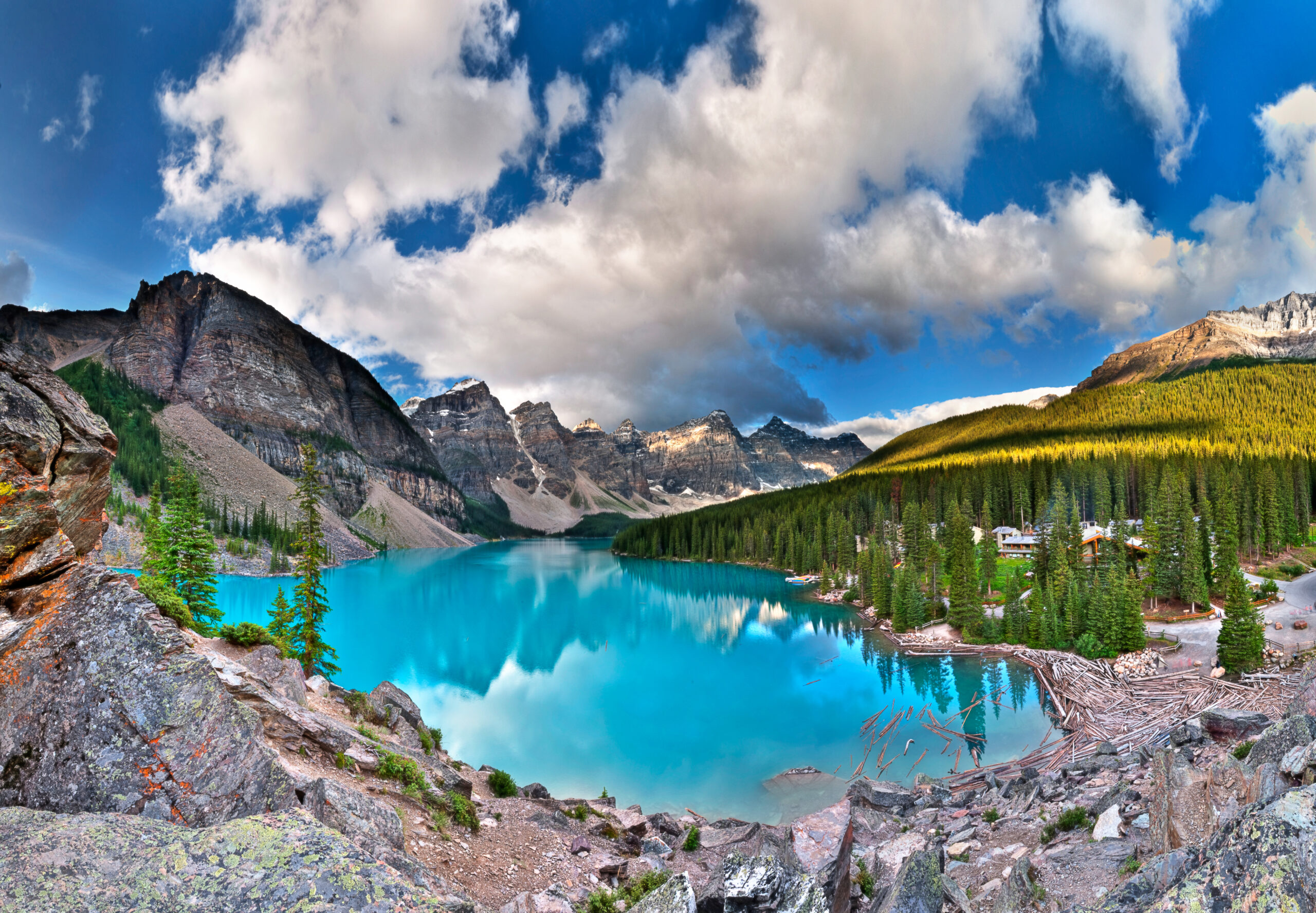
Featured photograph: Moraine Lake, Alberta. Photo: Mike Boehmer (2009), Wikimedia Commons, CC BY 2.0.

Country profile | Reporting checked November 13, 2026. Monetary figures are in Canadian dollars unless otherwise stated; reference years are identified because official datasets are released on different schedules.
In one photograph, Canada is a turquoise mountain lake; in another, it is Toronto’s waterfront skyline. Between those familiar images lies the more interesting country: French-speaking streets above the St. Lawrence, Atlantic fishing communities, prairie cities, Indigenous homelands and a working economy that builds aircraft, generates electricity and connects resources to world markets. The landscape is immense. The national story becomes clearer at the scale of a city, a meal or a skilled trade.
Canada’s strengths are not divided neatly between wilderness and modernity. Its waterways are scenery and power sources; its cities are centres of finance and places where newcomers reshape the food culture; its heritage sites are living communities as well as destinations. This profile follows those connections, from the country’s regional character to the industries and everyday experiences that sustain it.
A country best understood through its regions
Canada has ten provinces and three territories, with Ottawa as its federal capital. The government’s regional guide describes five broad geographic groupings: Atlantic Canada, Central Canada, the Prairies, the West Coast and the North. Each offers a different introduction to the country. Coastal fisheries and maritime communities are not the same experience as a prairie city or a northern settlement, and that variety is one of Canada’s most important attractions.
The practical lesson for visitors is to choose a region rather than try to “do Canada” in one short trip. The federal EduCanada regional guide highlights the West Coast’s mountains, Quebec’s French-Canadian culture and Atlantic ocean scenery. A regional journey leaves room for the smaller places between major attractions, where local markets, waterfronts and community events often reveal more than a hurried cross-country itinerary.


The people behind the country’s many identities
The 2021 Census recorded more than 450 ethnic or cultural origins. These are self-reported ancestries, and people can report several: they should not be treated as mutually exclusive racial categories. European ancestry remains a substantial part of the population; Statistics Canada counted just over 19 million people reporting European origins, including people who reported other origins as well.
The census’s separate population-group measure identified South Asian people as 7.1% of the population, Chinese people as 4.7% and Black people as 4.3%, according to Statistics Canada. A separate Indigenous-identity count recorded 1.8 million First Nations, Métis and Inuit people, or 5.0%, in 2021. These dated measures describe different aspects of identity; adding them together would misrepresent the country. In daily life, they translate into many languages, family histories, religious traditions and connections overseas, not one standard Canadian background.
An economy with more than one engine
Canada’s economic base combines services, manufacturing and natural-resource industries. Banking, communications, education, transport and tourism sit alongside aerospace, vehicles, machinery, food production, forestry, mining and energy. The government’s economic overview illustrates how these activities connect through trade. A forest product, an aircraft component and a financial service are very different exports, but all rely on skills, logistics and relationships beyond Canada’s borders.
The latest annual provincial and territorial accounts, released by Statistics Canada on November 5, 2026, put real GDP growth in 2025 at 1.9%. Every province recorded growth, as did Yukon and Nunavut; the Northwest Territories contracted. Household expenditure, government expenditure and capital investment supported the national increase. Business investment in computers and peripherals rose 14.1%, even as some other equipment categories weakened. These are measured results, not a claim that every region or household experienced the same improvement.
Montréal makes that diversity concrete. Canada Economic Development for Quebec Regions identifies aerospace, life sciences, information and communications technologies and multimedia among the city’s high-value industries, alongside its cultural and commercial sectors. A city celebrated for creative life is also a place where engineering and advanced manufacturing matter. That combination is a better guide to the economy than an image of Canada as simply a supplier of raw materials.
Finance and development: building capacity for the next decade
In its 2026 economic and fiscal overview, the federal government identifies natural resources, skilled workers, research institutions and access to markets as advantages it wants to turn into stronger productivity and investment. It also acknowledges affordability pressures and a difficult trade environment. The document’s forecasts and fiscal targets are government projections, not completed results. Its broad direction is nonetheless clear: attract capital, accelerate projects, strengthen internal trade and reduce reliance on any one external market.
The government’s budget summary also highlights investment in quantum technology and artificial intelligence, as well as work on an ocean strategy. Those priorities reflect the effort to make advanced technology and resource development reinforce one another. The test will be delivery: research must become useful products, proposed infrastructure must become working infrastructure, and investment must produce benefits that reach communities rather than remaining an announcement.


Natural resources remain a substantial national asset
Canada’s resource story is not only about oil. Its minerals, forests and energy industries provide materials used in buildings, electricity systems, transport and manufacturing. Natural Resources Canada’s 2024 resource facts report that the sector accounted for 16% of nominal GDP, or $459 billion, when direct and indirect activity are combined. That distinction matters: it includes the wider supply chain, not just production at mines, mills or energy facilities.
The country produced more than 60 minerals and metals worth $64.3 billion in 2024, according to Natural Resources Canada. Critical minerals link established mining expertise to newer industries, including batteries and other clean-energy technologies. Resource wealth is therefore both an existing strength and a development responsibility. Long-term value depends on infrastructure, skilled workers, environmental performance and relationships with the communities where projects operate.
A distinctive electricity advantage
The Canadian Centre for Energy Information’s fall 2026 fact book reports that Canada generated 623 terawatt-hours of electricity in 2024. Renewables supplied 65%, while non-greenhouse-gas-emitting sources, including nuclear, supplied 78%. Hydroelectricity alone accounted for 53%. This is an important distinction from the country’s broader energy mix, which also includes substantial oil and gas production.
For an economy pursuing new industrial investment, electricity is more than a utility bill. Its availability and composition shape where facilities can operate and how products are made. Canada’s hydropower and nuclear base gives it a meaningful platform, although actual access, capacity and prices vary by province and project. A national strength should never be mistaken for an identical local offer everywhere.
Wildlife found nowhere else
Canada’s wildlife includes species whose entire natural range lies inside the country. The endangered Vancouver Island marmot, for example, lives only in mountainous areas of Vancouver Island, British Columbia. That makes it endemic, a more specific description than merely native. Its restricted home gives Canada a particular responsibility for its survival. Wildlife is not just a scenic extra here: the country’s forests, wetlands, mountains and northern landscapes are habitats on which distinct forms of life depend.


Tourism is both an experience and an export
Statistics Canada’s 2025 tourism profile records $140.5 billion in spending by domestic and international visitors, a 2.8% increase. Tourism supported 687,800 direct jobs. International visitors accounted for $34.9 billion of spending, showing why travel is an export industry as well as a leisure activity: money earned abroad supports Canadian accommodation, transport, food and experiences.
City life gives that travel economy texture. Destination Canada’s coast-to-coast city guide connects Vancouver, Calgary, Winnipeg, Toronto, Montréal and Halifax rather than presenting one urban model. In Winnipeg, The Forks is associated with thousands of years of Indigenous gathering and trade; in Halifax, the waterfront and maritime setting lead the story in another direction. These differences are the reason to explore more than one region, not an invitation to rush through the whole country in a week.
Canada’s protected landscapes offer substantial depth. Parks Canada lists 37 national parks and 11 national park reserves representing 31 terrestrial natural regions. The system includes much more than famous mountain scenery. Visitors can encounter coastal ecosystems, northern landscapes and places where natural and human histories are closely connected. Conservation is part of the attraction: these places have value because their character is protected, not because every part has been developed for visitors.
Culture belongs to the people who live it
Canada’s English and French official-language traditions exist alongside the distinct cultures of First Nations, Inuit and Métis peoples and generations of newcomers. The federal citizenship guide describes this layered national identity. Understanding it means resisting the idea that one language, region or image can represent everyone. Indigenous cultures are contemporary and living, not simply a historical introduction to the country.
That is why Indigenous-led experiences highlighted by Parks Canada are particularly valuable. Examples include Inuvialuit-hosted camping in Ivvavik, Inuit-guided activities in northern parks, the Haida Gwaii Watchmen and Mi’kmaw cultural experiences in Nova Scotia. Such encounters allow communities to explain their own relationships with land, language and history. They also give travellers a richer understanding than scenery viewed without context.
Culture is also an economic activity. Statistics Canada’s cultural indicators put combined nominal GDP attributable to culture and sport at $75.4 billion in 2024, up 4.4%. The figure does not reduce culture to money; it demonstrates that creative work and recreation are part of the country’s productive life, not a decorative addition to it.
The North deserves more than a line about remoteness. Iqaluit, Nunavut’s capital, is a contemporary community where Inuit language, art and knowledge are part of everyday life. The City of Iqaluit points visitors to Nunatta Sunakkutaangit Museum and Unikkaarvik Visitor Centre and describes opportunities to encounter carvings and local handicrafts. Looking at the North through its people, rather than simply through ice and distance, changes the picture of Canada.


Festivals, sporting pride and international recognition
Canada’s calendar makes regional identity public. The Calgary Stampede celebrates Western heritage, while the Toronto International Film Festival puts screen culture in the spotlight. Destination Canada’s festival guide also draws attention to Winnipeg’s folk and multicultural celebrations and the Adäka Cultural Festival in Whitehorse, where Indigenous arts, storytelling and performance are central. These are not different costumes for one national culture; they are expressions of communities with their own histories and creative lives.
Sport provides another shared vocabulary. At Paris 2024, Canada won 27 Olympic medals, including nine golds. Summer McIntosh became the first Canadian to win three gold medals at a single Olympic Games. It is an achievement that broadens the international picture of a country often associated first with winter sport: swimming, athletics and many other disciplines also produce moments of national pride.
On the international pageant stage, the Miss Universe organization records Canadian winners Karen Dianne Baldwin in 1982 and Natalie Glebova in 2005. At Miss World 1984, Canada’s Constance “Connie” Fitzpatrick was first runner-up. Those are distinct competitions and results, worth recording accurately rather than turning every notable appearance into a world title.
Beyond the postcard: places with a story to tell
Old Québec rewards attention to the built landscape. Its fortified historic district, recognized by UNESCO, offers a visible record of the colonial city above the St. Lawrence. Farther east, Nova Scotia’s Old Town Lunenburg preserves the plan and wooden architecture of a British colonial settlement. These are not interchangeable “historic towns”: their different histories help explain the country’s regional character. Parks Canada’s account of the country’s World Heritage places also points to less familiar discoveries, including the fossil record at Miguasha on Quebec’s Gaspé Peninsula, associated with the Devonian “Age of Fishes”.
The point is to vary the scale of a Canadian journey. A major city supplies museums, restaurants and performances; a coastal settlement gives the shoreline a human dimension; a protected geological site reveals a history measured in millions of years. Peggy’s Cove’s lighthouse and granite shore, pictured here, belong to that Atlantic visual identity. Niagara, pictured later in this profile, presents a very different landscape: a river and waterfall system seen across an international border, with the American Falls visible from Ontario.
Food: regional traditions and a changing national table
A Canadian food journey can begin with Atlantic lobster or Quebec poutine, two examples highlighted by EduCanada, but it should not stop at a list of national favourites. In Vancouver, Destination Canada’s culinary guide describes a restaurant culture shaped by dim sum, Korean barbecue, ramen, Indian cooking and sushi. The city’s food tells a Pacific story, just as seafood tells an Atlantic one. Eating locally can mean understanding migration as well as geography.
The Canadian Museum of Immigration at Pier 21 describes food as an evolving expression of belonging. Indigenous cooks maintain and renew traditions while newcomers introduce ingredients and techniques that become part of everyday Canadian life. A meal can carry family memory, regional history and a new local identity at the same time. This makes the national table especially interesting: its character is not fixed, and its variety is one of its strengths.
Maple syrup is both a familiar flavour and a real agricultural industry. Natural Resources Canada identifies Canada as the world’s largest producer. Its importance connects the national table to forests, seasonal conditions and skilled producers. Alongside the changing restaurant culture, it is a reminder that some of Canada’s best-known foods remain tied closely to the land.


Everyday life: seasons, neighbourhoods and public services
Canada’s seasons affect everyday routines as well as travel. The government’s land and climate guide describes four seasons and substantial regional differences. Winter is not the same experience on the Pacific coast as it is in the interior or the North. Seasonal clothing, transportation and outdoor plans are practical parts of life, while summer and autumn create a different rhythm of festivals, parks and community activity.
Publicly funded health care is another important part of the national picture, but it requires precise description. Health Canada explains that eligible residents apply through provincial or territorial insurance systems. It is not a blanket promise that all services are free for every visitor. For people considering a longer stay, local eligibility, housing, transport and the actual cost of living deserve as much attention as attractive national statistics.
The broader picture
Canada’s positive story is strongest when it is specific: a diversified economy, substantial resources, a relatively low-emissions electricity base, distinctive regional cultures and a tourism offering that ranges from major cities to remote landscapes. Its development opportunities sit at the intersection of those strengths. The challenge is to turn potential into lasting value while protecting the places and communities that make the country distinctive.
For readers encountering Canada through this new column, that is the useful starting point. Look beyond a single skyline or postcard lake. The country’s appeal comes from the relationship between its people, its working economy and its extraordinary geography, and from the many different ways those relationships are expressed.
About this positive-focus profile: This feature highlights the country’s strengths, achievements, culture and attractions. That focus does not overlook or minimise the social, economic, public-safety and other challenges that every country faces. It is a selective introduction to what the country offers, not a comprehensive assessment of conditions or risks.
Leave a Reply