
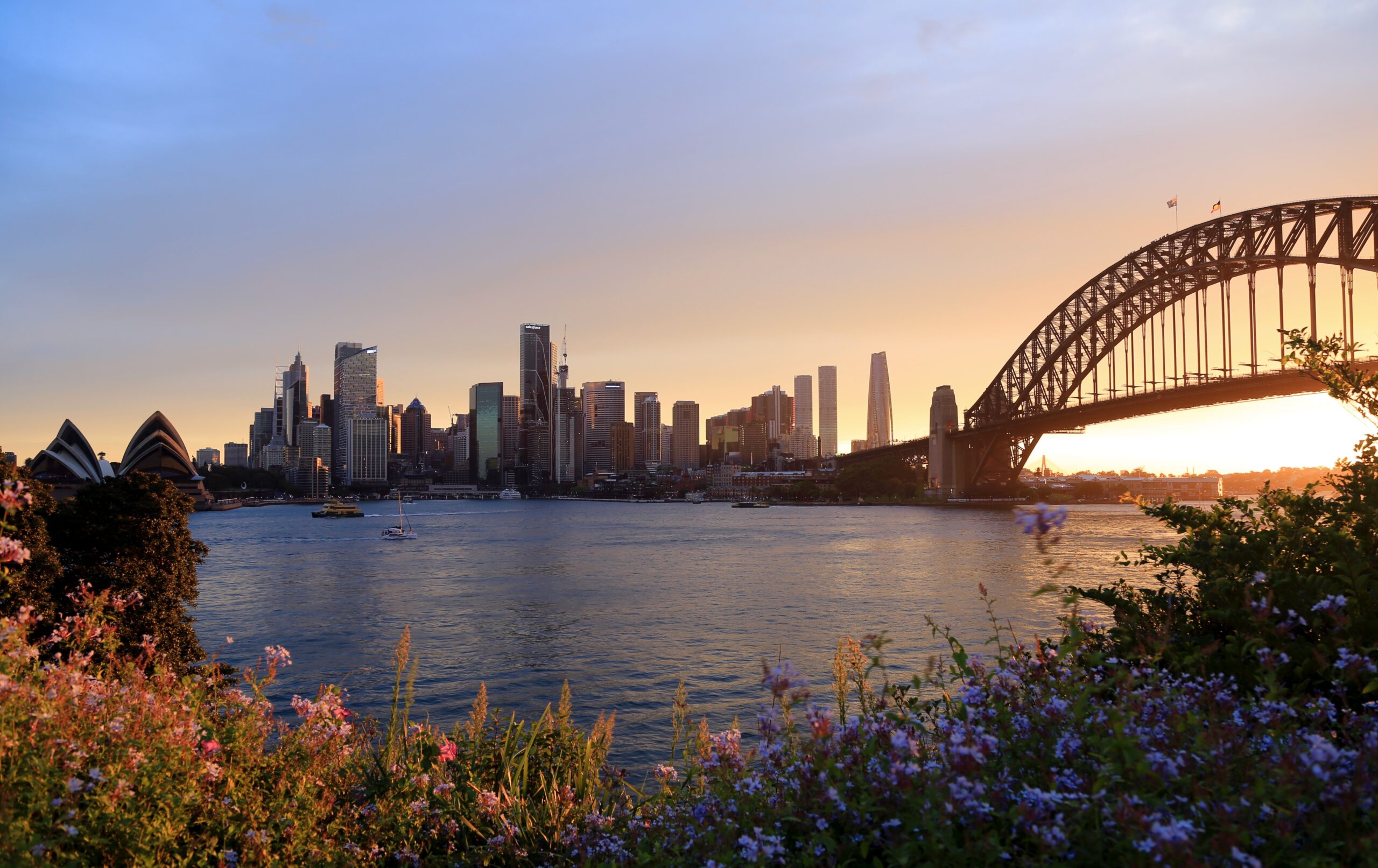
Featured photograph: Sydney Harbour, with the Sydney Opera House at left and Harbour Bridge at right, at sunset, 23 February 2025. Photo: Stu’s Images / CC BY-SA 4.0.

A ferry crossing Sydney Harbour, a coffee ordered in a Melbourne laneway and a walk beneath the desert sky reveal different versions of Australia. None is the whole country. The continent holds tropical coasts, temperate vineyards, red inland landscapes and cities shaped by migration, while First Nations cultures give places meanings that reach far beyond a visitor’s photograph. Australia’s appeal comes from moving between these worlds, rather than reducing it to a beach or a single famous building.
The same breadth runs through its economy. Iron ore and lithium connect remote production regions to global industry; farms and fisheries feed export markets; universities and research institutions bring people and ideas across borders. Natural wealth is part of the explanation, but so are the skills, institutions and everyday creativity that turn resources into livelihoods.
A country with many identities
Australia is a federation of six states, with Canberra as the national capital and self-government arrangements in the Australian Capital Territory and Northern Territory. Its parliamentary democracy provides the framework within which those different regions operate. But a constitutional description is only a starting point. A coastal metropolis, an agricultural community, a mining region and a remote settlement can have sharply different rhythms and priorities. Source: Department of Foreign Affairs and Trade.
Migration is an important part of that variety. The Australian Bureau of Statistics estimated that 8.8 million residents were born overseas in June 2025, representing 32% of the population. Nearly every country was represented among residents’ birthplaces. These figures help explain why Australian culture cannot be reduced to one ancestry or one menu: international connections are part of ordinary neighbourhood life, family networks and business relationships. Source: ABS.
A population with many ancestries
The 2021 Census offers a more precise picture of that diversity than the simple label “multicultural.” The most commonly reported ancestries were English (33.0%), Australian (29.9%), Irish (9.5%), Scottish (8.6%) and Chinese (5.5%). People could report up to two ancestries, so those shares overlap; they are not mutually exclusive racial categories. The same census counted 812,728 Aboriginal and/or Torres Strait Islander people, 3.2% of the population. These are census counts from 2021, rather than subsequent adjusted population estimates. Source: ABS snapshot; First Nations census results.
That mix is visible in much more than statistics. It helps shape neighbourhood restaurants, languages heard on public transport, places of worship and the family stories behind local businesses. First Nations cultures are foundational to the country, while successive migrations have added further layers. Understanding both allows Australia to be seen as a society that continues to develop, rather than a fixed collection of national symbols.
First Nations cultures belong at the centre
Australia’s Aboriginal and Torres Strait Islander peoples are not a single cultural group. Tourism Australia emphasises the diversity of their languages, traditions, food knowledge and relationships with Country. That diversity is essential to understanding the continent. A visitor who encounters one community’s stories has encountered that community, not a universal script that can be applied everywhere. Source: Tourism Australia, First Nations cultures.
Indigenous-led experiences can introduce visitors to landscapes through knowledge that a scenic photograph cannot convey: seasonal food sources, cultural responsibilities and the meaning of a place. The Australian Government also acknowledges the history of mistreatment and the continuing work of reconciliation. Recognising that history does not diminish a positive profile. It makes it more respectful, allowing the achievements, living cultures and contributions of First Nations peoples to be understood on their own terms. Source: DFAT.


A broad economy, not simply a mining economy
In its annual national accounts released in October 2026, the ABS reported that Australia’s economy grew 2.3% in real terms in the 2025–26 financial year. GDP per person increased 0.8%. The distinction matters: growth in the economy as a whole and growth per person answer different questions. Source: ABS annual national accounts.
Australia’s economic breadth is one of its advantages. Resources support exports, but the country also needs the professional services, transport, education, construction, health care and technology that make a modern economy function. A mine requires more than ore; it requires engineers, financing, logistics and environmental management. A visitor economy requires more than beautiful scenery; it requires hospitality skills, reliable transport and businesses capable of serving people from different markets.
Natural resources with international importance
Geoscience Australia’s 2025 mineral assessment, covering 2024, ranked Australia first in world production of iron ore and lithium. It also placed the country among the leading producers of bauxite, gold, rare earths and several other minerals. Source: Geoscience Australia.
The importance of those resources extends well beyond the mine gate. Iron ore supports steelmaking, while lithium and other critical minerals connect Australia to changing energy and technology supply chains. Resource development also depends on infrastructure, skilled workers, market demand and responsible environmental management. Having a deposit is not the same as having a profitable operating project. Even so, Australia’s established knowledge in exploration and mining gives it a substantial base from which to participate in new industrial opportunities.


Finance and long-term capital
Australia’s retirement-savings system is also a major part of its financial landscape. The Australian Prudential Regulation Authority reported total superannuation assets of about A$4.8 trillion at June 2026, including around A$3.4 trillion in APRA-regulated funds. Source: APRA.
This pool of retirement savings sustains a substantial professional ecosystem: fund managers, administrators, actuaries, investment analysts and regulators. For a country profile, that is a useful counterweight to the familiar images of farms and mines. Australia produces and exports physical goods, but it also has institutions managing long-term financial commitments for millions of people.
Development and a changing energy system
Australia’s energy resources include an expanding renewable-electricity contribution. Government energy statistics put renewables at 39.6% of total electricity generation in calendar 2025. That measure should not be confused with the renewable share of all energy consumption, which includes transport fuels and other uses. The change creates work in generation, transmission, storage, engineering and system operation, as well as debate about the pace and cost of transition. Source: Australian Energy Statistics.
Transport investment is another part of the development picture. The federal government’s 2026–27 Infrastructure Investment Program supports new land-transport projects and additional funding for existing programmes. Infrastructure Australia separately assesses priorities for planning and investment. Those programmes illustrate the practical challenge of connecting a large country: productivity and access depend on networks that work, not simply on announcing new construction. Funding commitments and priority lists are not the same as completed projects. Source: Infrastructure Investment Program.
Uluru: natural grandeur and living Country
Uluru is instantly recognisable in a photograph, but recognition is not the same as understanding. Parks Australia’s walking information describes routes around the base and explains that particular places carry sacred meanings for Aṉangu. The experience is richer when the rock is approached as part of living Country, not as a scenic object detached from its custodians. Walking, listening and observing local guidance offer a more meaningful encounter than collecting a distant view. Source: Parks Australia.


Tourism: a real industry built on remarkable places
The ABS estimated direct tourism GDP at A$81.1 billion in current prices in 2024–25, with 696,000 filled tourism jobs. Real tourism GDP grew 0.7%. The word “direct” is important: this is not an estimate of every indirect economic effect associated with travel. It nevertheless demonstrates that tourism is a substantial source of work, connecting accommodation and transport with food, retail, culture and recreation. Source: ABS Tourism Satellite Account.
Australia’s World Heritage list helps explain that attraction. The federal environment department lists 21 properties, ranging from the Great Barrier Reef and Ningaloo Coast to the Tasmanian Wilderness, Sydney Opera House, Budj Bim Cultural Landscape and Murujuga Cultural Landscape. These places are not interchangeable. Some are recognised primarily for natural values, others for cultural significance, and several combine both. Source: Department of Climate Change, Energy, the Environment and Water.
These places invite different kinds of attention. Reef systems reward looking beneath the water, while an opera house demonstrates what architecture can contribute to a city’s identity. Budj Bim and Murujuga place Aboriginal cultural knowledge and achievement within the national heritage story. Together, the list is a useful antidote to the idea that Australia’s attractions are exclusively natural: human creativity is part of its internationally recognised significance too.


Cities with their own character
Sydney’s harbour gives the city an unusually strong connection between a landmark view and everyday transport: the Opera House and Harbour Bridge share the scene with working ferries. Melbourne’s identity is more readily explored at street level, through laneways, cafés, restaurants and art. Tourism Australia’s local guide singles out Crossley Street, Degraves Street and Centre Place as concentrated examples of that laneway culture. A city’s appeal is not always a monument; sometimes it is the density of small places that makes walking worthwhile. Source: Tourism Australia.
The country’s transport options reflect that scale. Tourism Australia describes domestic flights, road journeys, city ferries and long-distance rail experiences, including the Indian Pacific and the Ghan. A ferry journey can be part of ordinary city transport and a visitor experience at the same time. Longer routes can reveal the changing landscape, but require realistic time allowances rather than assumptions based on travel in smaller countries. Source: Tourism Australia, getting around.
The Sydney Opera House deserves more than a passing mention. Opened on October 20, 1973, the building designed by Danish architect Jørn Utzon became a World Heritage property in 2007. Its familiar roof forms are part of the harbour view, but its purpose remains performance: a place where audiences gather for music, theatre and other live work. The landmark is visible at the left of this profile’s opening photograph, opposite the sweep of the Harbour Bridge. Source: National Museum of Australia; UNESCO.
Seasons that change the journey
Australia’s scale makes the timing of a trip important. In much of the temperate south, summer runs from December to February and winter from June to August. The tropical north is more usefully understood through wet and dry seasons, broadly November to April and May to October. A winter city break in Melbourne and a dry-season visit to the Top End can therefore offer very different conditions at the same time of year. Climate is part of the country’s variety, not just a footnote to packing. Source: Tourism Australia.
Animals that make the continent unmistakable
A kangaroo in open country is among Australia’s most recognisable sights, but the continent’s wildlife rewards looking beyond its best-known marsupials. The platypus is endemic to Australia: an egg-laying mammal adapted to freshwater environments, combining a bill, webbed feet and a dense waterproof coat. The Australian Museum’s species account makes clear why it has fascinated scientists as well as visitors. Its home is a river or stream, not the dry red landscape often used to represent the entire country.
Tasmania contributes another distinctive animal, the Tasmanian devil, whose powerful jaws and nocturnal habits have made it a symbol of the island. Conservation work against devil facial tumour disease is central to its modern story. Native wildlife is a reason to travel thoughtfully: keep a respectful distance, avoid feeding animals and follow park guidance. Seeing an animal behaving naturally is more rewarding than turning it into a prop. Source: Tasmania Parks and Wildlife Service.


Festivals, performance and shared celebration
NAIDOC Week, held in July, celebrates the history, culture and achievements of Aboriginal and Torres Strait Islander peoples. Its significance goes beyond a visitor event: it is an opportunity for communities to honour their own contributions and for others to listen and learn. Source: National NAIDOC Committee. Adelaide Fringe offers a different expression of cultural energy, filling venues with theatre, comedy, music, circus and cabaret. Its open-access format makes room for experimentation alongside established performers. Together, these events illustrate a country whose culture is performed and debated in public, not confined to museums. Source: City of Adelaide.
The coast and the working landscape
The agricultural story adds another dimension to the country’s natural wealth. ABARES, the research bureau within the Department of Agriculture, Fisheries and Forestry, describes a sector shaped by exports, productivity and changing market conditions. Its 2026 snapshot identifies grains, oilseeds and pulses as particularly strong long-term export performers, alongside meat and livestock. This is a reminder that the landscape is productive as well as picturesque. Source: ABARES.
Agriculture connects distant regions to urban consumers and overseas buyers. It supports transport, processing, equipment, research and regional services, while giving many communities a distinct local identity. For a traveller, markets and regional food experiences can provide a more grounded introduction to a place than a list of famous sights. For a business reader, the same landscape reveals a network of supply chains and specialist skills that links rural Australia with the wider world.
On Victoria’s Great Ocean Road, the Twelve Apostles present a different kind of drama: limestone stacks standing off a coastline of cliffs and breaking waves. The photograph here captures that meeting of rock and sea. These regional landscapes give road journeys an appeal quite different from a city break.


Food that reflects the people and the place
Australian food is best understood as a conversation between local ingredients and many cultural influences. Tourism Australia describes a cuisine shaped by native ingredients, migration and varied landscapes. The experience can be as simple as seafood, a meat pie or breakfast in a café, or as elaborate as contemporary restaurant cooking. Coffee culture is part of that everyday scene, but it sits alongside a much wider range of food traditions. Source: Tourism Australia’s cuisine guide.
Hobart’s Salamanca Market offers a particularly tangible meeting of food, place and creativity. Beginning with 15 stalls in 1972, the Saturday market now stretches through Salamanca Place with produce, prepared food, pottery, artwork and other locally made goods. It allows visitors to meet makers and growers rather than encounter Tasmania only through a restaurant menu. That relationship between regional production and urban gathering places is one of the pleasures of travelling beyond the largest Australian cities. Source: Tourism Tasmania.
Science, education and useful invention
Australian innovation has produced contributions that travel much farther than the country’s borders. CSIRO describes how its researchers developed and patented wireless local-area-network technology that helped underpin modern Wi-Fi. It is a useful example of specialist scientific work becoming part of everyday global life. Source: CSIRO.
International education adds another layer of connection. Australia’s Department of Education describes it as a source of economic, cultural and social benefits. Students bring international perspectives to campuses and communities, while graduates create networks across countries. Education is therefore both an industry and a form of people-to-people exchange. Its value includes research partnerships and professional relationships that can continue long after a particular course has ended. Source: Department of Education.
Champions and international cultural milestones
At Paris 2024, Australia won 53 Olympic medals: 18 gold, 19 silver and 16 bronze. The gold total was its highest at a single Olympics. Swimming and paddling helped create memorable national moments, with athletes including Kaylee McKeown, Ariarne Titmus and Jessica Fox among the champions. Sport gives Australians a language of shared achievement across a continent where communities can be separated by enormous distances. Source: Olympics medal record.
International cultural milestones also include Australia’s success in the major global pageants. Kerry Anne Wells won Miss Universe in 1972 and Jennifer Hawkins in 2004; Penelope Plummer won Miss World in 1968 and Belinda Green in 1972. These are distinct competitions and historical achievements, not measures of a country’s people or cultural worth. They belong in the wider record of Australians reaching international audiences alongside performers, artists and athletes. Source: Miss Universe; Miss World; National Museum of Australia.
Beyond the familiar postcard
Farther west, the Pinnacles of Nambung National Park rise from yellow sand in Western Australia. The regional tourism authority describes them as natural limestone structures. Their sculptural forms offer a less internationally familiar alternative to the country’s best-known postcard landscapes. Source: Australia’s Coral Coast.


Daily life beyond the postcard
The government-backed Study Australia site describes outdoor recreation, cafés and diverse communities as features of Australian life. Those are useful starting points, but they should not become promises about every person’s experience. Daily life depends on location, work, housing, income and family circumstances. A beach nearby does not remove the demands of employment or the cost of living; a major city does not represent all regional communities. Source: Study Australia.
For a broader view, follow the links between the country’s pleasures and its productive life. Seafood brings the coast to the table; a regional market makes agriculture visible; an exhibition or performance draws on a city’s creative workforce. A rail journey links settlements that can look isolated on a map. The same connections that sustain communities also give visitors ways to understand them.
The positive story is therefore larger than a famous landmark or an export statistic. Australia offers a meeting point between natural abundance and human capability: the ability to study, build, grow, create and connect across a vast space. Seen in that way, its appeal is not only what visitors can look at, but what its people and institutions continue to make from the opportunities around them.
About this positive-focus profile: This feature highlights the country’s strengths, achievements, culture and attractions. That focus does not overlook or minimise the social, economic, public-safety and other challenges that every country faces. It is a selective introduction to what the country offers, not a comprehensive assessment of conditions or risks.
Country profile prepared for Tito Baron Media. Monetary values are Australian dollars unless stated otherwise. Figures retain their reference periods; planned investments are not presented as completed developments.
Leave a Reply