
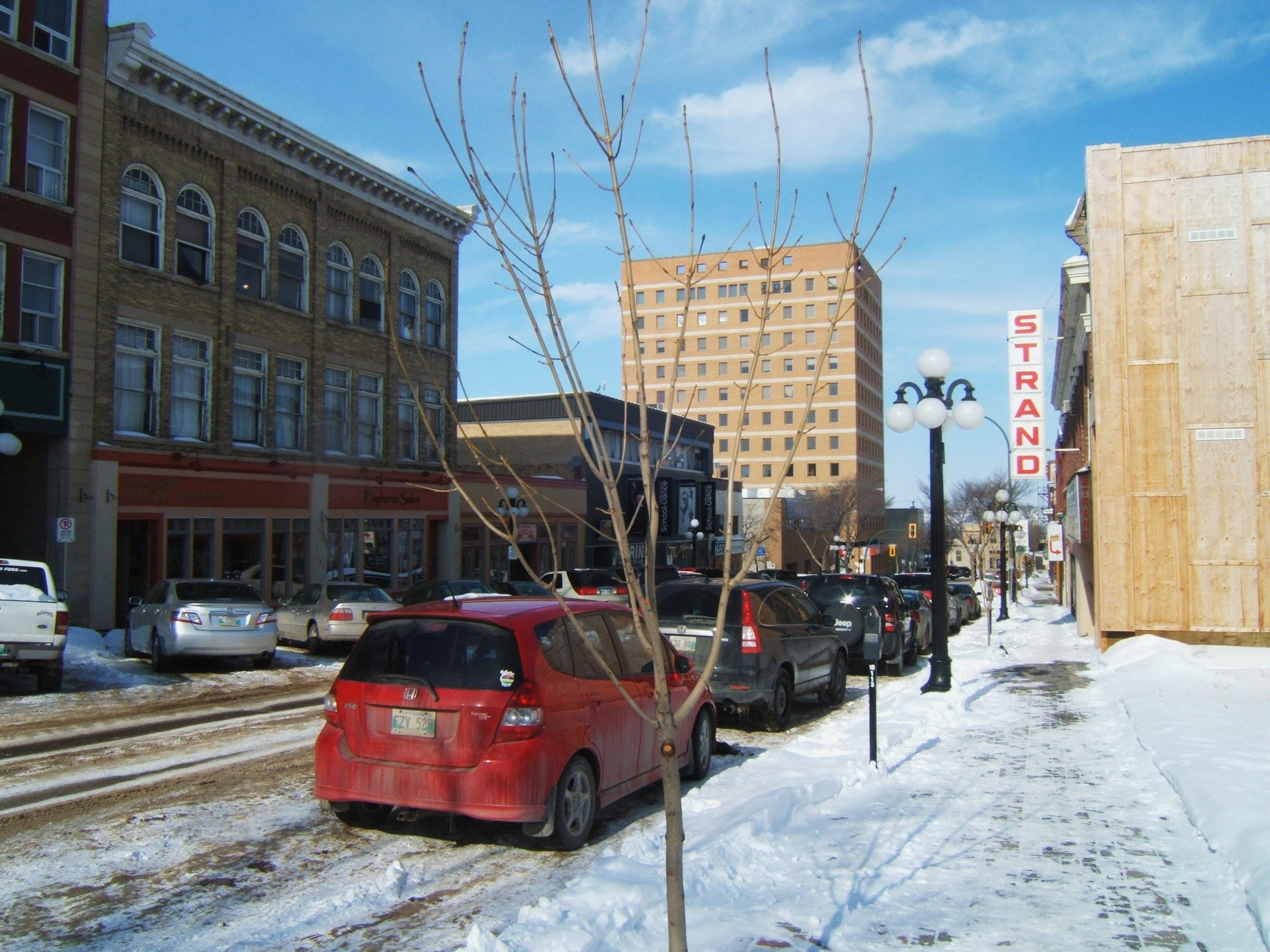
Downtown Brandon, Manitoba, in February 2013. Brandon is one of the 14 communities participating in the rural immigration pilot. File photo: Jd.101 / Wikimedia Commons, CC BY-SA 3.0. Image reused without editorial alteration.

The Rural Community Immigration Program opens on January 1, 2027, offering eligible workers a route to permanent residence through designated employers and participating communities.
Canada has made its Rural Community Immigration Pilot permanent, giving workers planning a future in smaller communities a continuing pathway to permanent residence.
Immigration Minister Lena Metlege Diab announced the change in Pictou County, Nova Scotia, on November 9, 2026. The permanent Rural Community Immigration Program opens on January 1, 2027.
For prospective applicants, the opportunity depends on finding an eligible job with an approved employer and receiving a community recommendation. Moving to a rural area or receiving an ordinary job offer does not, by itself, qualify someone for permanent residence.
What has Canada changed?
The government is turning a temporary pilot into an established economic immigration program. The existing pilot already offered a route to permanent residence; the change makes the program itself permanent.
According to IRCC’s announcement, the approach is intended to help employers fill persistent vacancies and help newcomers and their families build long-term lives in rural communities. Expansion beyond the current communities is planned, but the government has not announced the additional locations.
The 2027–2029 Immigration Levels Plan sets a target of 5,500 admissions in this category for 2027, followed by 6,000 in 2028 and 6,500 in 2029. The later targets can be adjusted. These figures include admissions from outstanding applications under earlier rural pilots, so they should not be read as an offer of 5,500 new jobs or application places.
Which communities are included?
IRCC says the 14 communities in the current pilot are expected to participate in the permanent program:
- Nova Scotia: Pictou County.
- Ontario: North Bay, Sudbury, Timmins, Sault Ste. Marie and Thunder Bay.
- Manitoba: Steinbach, Altona/Rhineland and Brandon.
- Saskatchewan: Moose Jaw.
- Alberta: Claresholm.
- British Columbia: West Kootenay, North Okanagan Shuswap and Peace Liard.
The list comes from IRCC’s program backgrounder. Each community identifies its own priority sectors and occupations and approves employers to participate. Applicants should use the community links on IRCC’s official job-offer page to check local requirements and recruitment information.
Who could benefit?
The route may suit workers whose skills match a participating community’s labour shortages and who genuinely intend to live there. Eligible candidates can apply from outside Canada or from within Canada. Those already in Canada must hold valid temporary resident status, according to the program’s regulatory explanation.
For readers in Trinidad and Tobago and the wider Caribbean, this means applying from overseas is possible. Eligibility still depends on the job, community recommendation and the applicant’s qualifications, rather than nationality alone.
International graduates can also benefit. Some graduates of public post-secondary institutions in the recommending community can qualify without the usual work-experience requirement. This exemption has specific rules covering the credential, full-time study, time lived in the community and how recently the applicant graduated.
For employers and communities, the intended benefit is a more reliable way to recruit and retain workers. IRCC says the pilot has helped fill shortages in health care, education, and sales and services. Actual opportunities depend on each community’s current priorities and employers’ vacancies.
What are the main eligibility requirements?
Under IRCC’s published eligibility criteria, applicants need a valid community recommendation, an eligible offer from a designated employer, qualifying work experience or an exemption, language results, education credentials and sufficient settlement funds where required.
A qualifying job offer: The regulations require full-time, non-seasonal employment with no fixed end date. The offer must meet wage and other program conditions, and at least 75 per cent of working hours must be in the designated community. A job from an employer that has not been designated cannot be assumed to qualify.
Work experience: Applicants generally need at least one year, or 1,560 hours, of related paid work during the previous three years. The relationship between the past work and the new job is assessed using Canada’s occupation classification system. Certain local international graduates are exempt, but graduating anywhere in Canada is not enough. Check the work-experience and graduate-exemption rules.
Language ability: An approved English or French test is required. The minimum benchmark depends on the job’s Training, Education, Experience and Responsibilities, or TEER, category: level 6 for TEER 0 or 1; level 5 for TEER 2 or 3; and level 4 for TEER 4 or 5. These are language benchmark levels, not IELTS band scores. IRCC accepts IELTS General Training, CELPIP-General and PTE Core for English, and TEF Canada and TCF Canada for French. Its language page explains the required test equivalents.
Education: Applicants need a Canadian high-school or recognized post-secondary credential, or a foreign equivalent supported by an educational credential assessment. For foreign qualifications, the assessment must be less than five years old when the application is submitted. See IRCC’s education requirements.
Settlement money: The required amount depends on family size and is updated periodically. Applicants already working in Canada with a valid work permit do not need to show settlement funds. Others should check IRCC’s current funds table before applying rather than relying on an older figure.
How does the application process work?
- Choose a participating community and check its priority occupations, designated employers and local application rules.
- Secure an eligible job offer from a designated employer.
- The employer submits the community-recommendation application for review. The community checks the job and the candidate’s eligibility.
- If a recommendation certificate is issued, submit the permanent-residence application through IRCC’s Permanent Residence Portal using the correct application package.
A community recommendation allows a candidate to apply; it does not guarantee federal approval. IRCC makes the final immigration decision, including admissibility checks. The new program’s application instructions apply to recommendations issued on or after January 1, 2027.
Can applicants work while waiting, and can family join?
After applying for permanent residence under the program, eligible applicants may also apply for a two-year employer-specific work permit. This permit allows work for the employer that made the qualifying offer while the permanent-residence application is processed.
A spouse or common-law partner may apply for an open work permit at the same time, but it restricts their work to the same community. These permissions require separate applications and are not automatic. See IRCC’s work-permit guidance.
The permanent-residence route also accommodates eligible accompanying spouses or partners and dependent children. Family members must be properly declared and meet applicable requirements, including medical examinations.
What about fees and processing times?
IRCC’s current economic immigration fee list shows CAN$1,590 for a principal applicant, including the processing and right-of-permanent-residence fees. It lists CAN$1,590 for an accompanying spouse or partner and CAN$270 per dependent child. Applicants should recheck the official fee list when applying.
Biometrics, medical examinations, language tests, police certificates, credential assessments and work permits can involve additional costs. The announcement does not promise a fixed approval time, so applicants should avoid making travel or employment decisions on claims of guaranteed or fast-track approval.
What should existing pilot applicants do?
IRCC says the pilot closes on January 1, 2027. However, applicants with a pilot recommendation dated December 31, 2026, or earlier can still submit their permanent-residence application before that recommendation expires. IRCC will continue processing applications already received.
Applicants should follow the pilot’s transition instructions and choose the application package matching their recommendation date.
For anyone considering this route, the practical starting point is an eligible employer and a community where their skills are needed. The permanent program creates a continuing opportunity, but job eligibility, local selection and federal approval remain essential.
Information checked against official Canadian government sources on November 11, 2026. This article provides general information, not advice on an individual immigration application.
Leave a Reply