
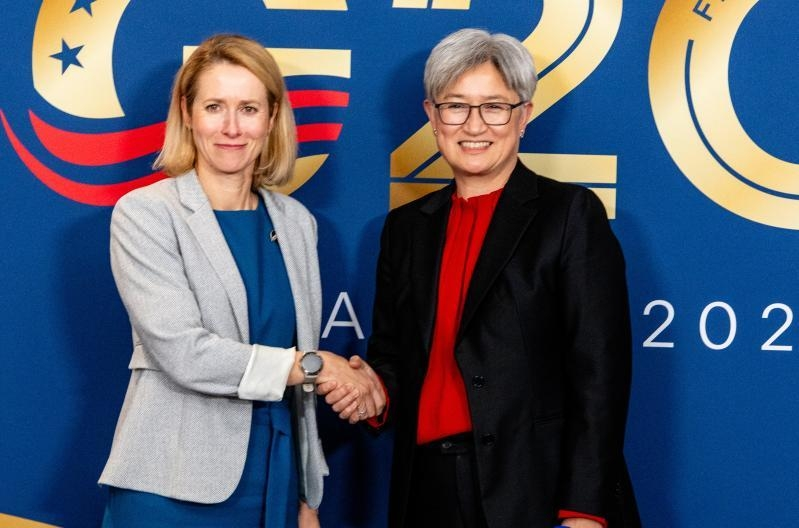
Photo: Kaja Kallas, right, and Penny Wong at the G20 Foreign Affairs Ministerial meeting in Atlanta, October 30, 2026. Source: European Commission Audiovisual Service, record P-070846. Licensed under CC BY 4.0. Image record.
Foreign ministers from the Group of 20 concluded two days of meetings in Atlanta without a joint communiqué, leaving the gathering with a chair’s statement rather than a negotiated declaration on the conflicts and economic pressures confronting the group.
The meeting took place on October 30 and 31, according to the United States chair’s statement. That document says ministers held candid discussions on U.S. priorities, including energy security, supply chain resilience and geopolitical tensions. It specifically identifies the Strait of Hormuz and the Bab al Mandab as areas discussed in the context of secure energy flows, navigation and critical infrastructure.
The absence of a common final document was significant. The Associated Press reported that the ministers did not reach consensus on several critical security issues, with divisions over Russia’s war in Ukraine among the factors that affected the outcome. Instead of issuing a joint communiqué, the group relied on a statement released by the chair, U.S. Secretary of State Marco Rubio.
A chair’s statement is not the same as a consensus communiqué. The U.S. document records subjects the presidency wanted to emphasize, including stable regulatory conditions, contractual frameworks for long term investment, food security, energy flows and supply chains for critical minerals. It does not state that members reached a shared position on the conflicts that shadowed the meeting.
Rubio acknowledged the limits of the talks at a closing news conference. “I wouldn’t pretend to you today that we are close to finding universally accepted solutions to these problems,” he said, according to AP. He also pointed to areas where countries could still work together, particularly supply chains and critical minerals.
That distinction framed the Atlanta meeting. Delegations could discuss practical economic issues while remaining far apart on major geopolitical questions. The chair’s statement said secure, resilient and uninterrupted energy flows, safe navigation through international waterways and the security of critical infrastructure are essential to global economic stability. It also said that using food trade as a tool of coercion is an increasingly frequent challenge in the trading system.
The political backdrop made agreement difficult. AP reported that ministers faced divisions not only over Ukraine, but also over the U.S. Israeli war against Iran, tariffs and disputes connected to China’s actions in the South China Sea. The traditional group photograph was canceled after objections to Russian Foreign Minister Sergey Lavrov’s inclusion, according to the report.
Polish Foreign Minister Radosław Sikorski, attending as a guest representative, summarized the challenge in comments reported by AP: “We have wars going on, and we have participants in those wars around the table, so it’s very difficult to agree on a common line.” The comment reflected the core reality of the meeting, a forum designed for cooperation operating amid active conflict and strained relationships.
Rubio had called the first day “very productive,” AP reported, and held side meetings with counterparts from Australia, India and Japan before the final session on freedom of navigation. In a separate social media statement, he said secure supply chains are essential for growth and argued that critical routes, including Hormuz and Bab al Mandab, must remain open to commerce.
The meeting closed with diplomacy still underway rather than a collective resolution. According to AP, participants agreed to keep trying to overcome their differences before the next G20 leaders’ summit. For Atlanta, the outcome was a record of the issues ministers discussed, not a consensus answer to them.
Sources
- U.S. Department of State, G20 Chair’s Statement
- Associated Press, G20 ministers end Atlanta meeting without consensus
- European Commission Audiovisual Service, image record P 070846
- European Commission Audiovisual Service, conditions of use
Source based reporting by Tito Baron Media.
Leave a Reply