
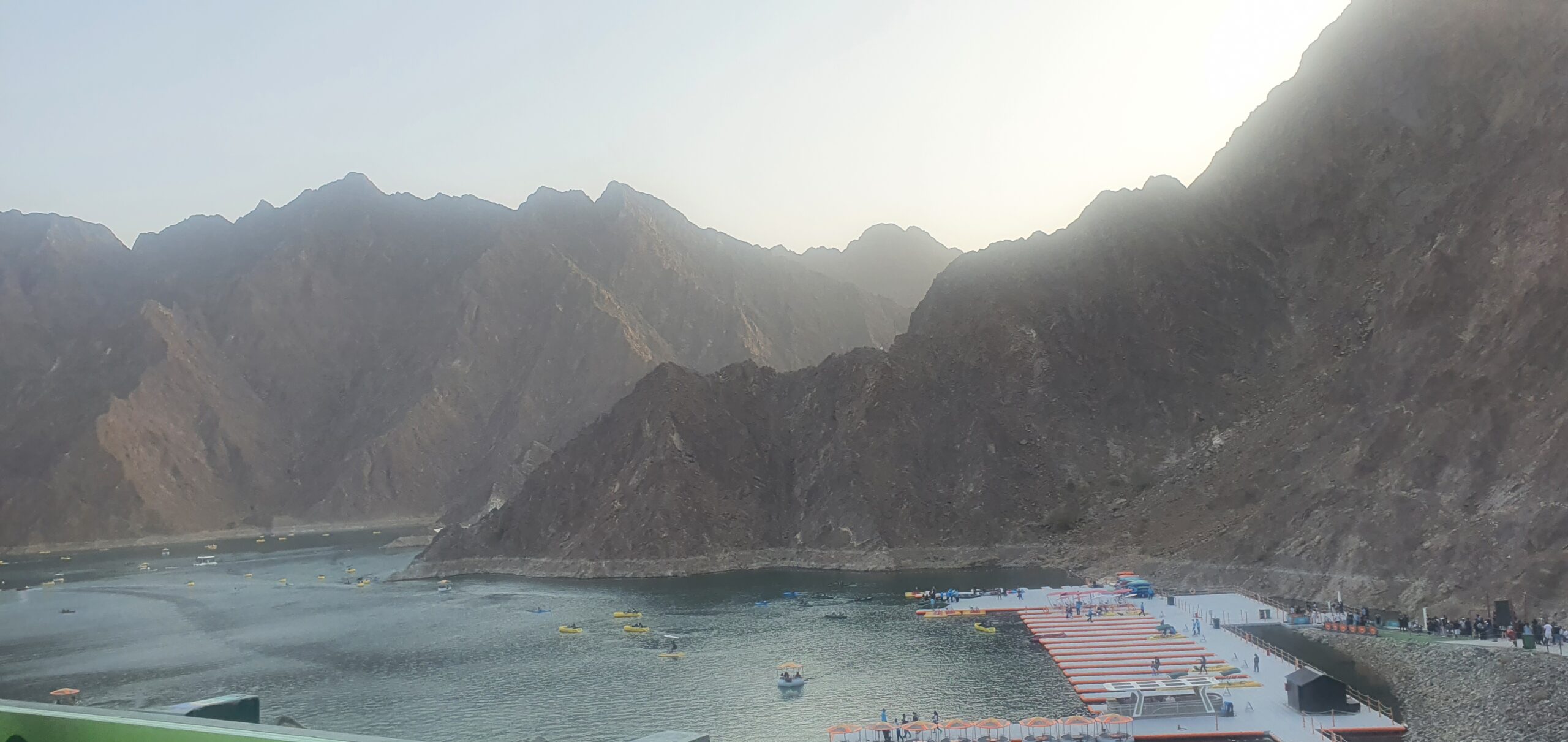
Featured photograph: Mountains and the reservoir at Hatta, March 2021. Photo: PranatiM17 / CC BY-SA 4.0.

A wooden abra crossing Dubai Creek and a spacecraft circling Mars belong to the same national story. So do the palm groves of Al Ain and the engineered fronds of Palm Jumeirah. In the United Arab Emirates, the contrast between inherited knowledge and modern ambition is not an abstract idea: it is visible in the way people move, build, trade and welcome guests. Beyond the spectacular skylines is a federation with seven distinct identities and several routes to prosperity.
Oil wealth helped transform the country, but the most interesting question is what has been built around it. Aviation, ports, financial services, manufacturing, tourism and scientific research now sit alongside the energy industry. For visitors, that economic diversification has a human face: the museum curator, the hotel chef, the desert guide, the artisan and the entrepreneur all offer a different introduction to the UAE.
Seven emirates, more than one national experience
The UAE is a federation of Abu Dhabi, Dubai, Sharjah, Ajman, Umm Al Quwain, Ras Al Khaimah and Fujairah. Abu Dhabi is the federal capital. The federation was established in 1971, while Ras Al Khaimah joined in 1972. Understanding that structure matters: the country is not simply Dubai on a larger map. Each emirate has its own landscape and economic character, while sharing a national framework. The UAE Government’s emirate guide is a useful starting point for that distinction.
Abu Dhabi combines government, energy and investment with cultural development. Dubai is especially associated with trade, aviation, tourism and international business. Sharjah offers a strong heritage and cultural dimension; Ras Al Khaimah brings mountain and coastal experiences; Fujairah opens onto the country’s eastern coast. Ajman and Umm Al Quwain widen the picture beyond the two best-known cities. The government’s explore-by-emirate guide describes that variety, from Al Ain’s oasis and Jebel Hafeet to mountain roads and coastal attractions.


Emirati roots, international communities
The federation’s cultural foundation is Emirati and Arab, but its everyday life is also shaped by residents who have arrived from across the world. In its 2022 UAE programme, the Smithsonian Folklife Festival described a population comprising approximately 11% citizens and 89% non-citizens. Those dated figures distinguish citizenship, not race or ethnicity. They help explain why an introduction to the country must encompass both Emirati heritage and the international communities participating in its schools, workplaces, neighbourhoods and restaurants. Arabic is the official language, while English is widely used in business and daily encounters. Source: UAE Ministry of Economy and Tourism.
An economy that is broader than oil
Oil remains an important part of the UAE’s economic foundation, but it does not describe the whole economy. Figures released by the Federal Competitiveness and Statistics Centre put real GDP growth at 6.2% in 2025 and non-oil growth at 6.8%. The centre identified trade, financial and insurance activities, construction and manufacturing among major non-oil contributors. These are official national-account results, rather than a claim that every sector or household experienced the same improvement. Source: FCSC.
Those sectors reinforce one another. A shipment arriving at a port needs warehouse space, finance, insurance and onward transport. A hotel development draws on construction, design, food suppliers and cultural programming. This is the practical meaning of diversification: not merely more sectors on a chart, but businesses generating demand for other businesses. The UAE’s location and investment in connections help turn that interdependence into a national economic asset.
Finance, investment and public priorities
Abu Dhabi’s international financial centre, ADGM, reported that assets under management rose 54% year on year in the first half of 2026. It counted 190 fund and asset managers and 276 funds, alongside 13,974 active licences. Those figures describe ADGM’s jurisdiction and should not be mistaken for the entire UAE financial sector. They nevertheless illustrate the scale of its development as a location for managing capital and professional expertise. Source: ADGM’s September 2026 announcement.
Public finances show another side of the development model. The originally approved 2026 federal budget set estimated revenue and expenditure at AED92.4 billion each. The Ministry of Finance framed the programme around investment in people, infrastructure and public services. This is a federal budget, not a consolidated total for all emirate governments, and a budget allocation is not the same as a final audited spending result. Keeping those distinctions clear makes the scale of public planning easier to understand without overstating it. Source: Ministry of Finance.


Infrastructure that connects business and people
The country’s geography has encouraged it to build around movement: aircraft, ships, goods, workers and visitors. Etihad Rail’s approximately 900-kilometre national network links cities, ports and industrial hubs from Ghuwaifat to Fujairah. Freight operations connect important parts of the production and logistics economy, while the operator describes passenger services as a phased development from 2026. Travellers should consult current schedules rather than assume every proposed passenger route is already running. Source: Etihad Rail.
There is a useful connection between this modern transport network and the older commercial landscape. Dubai Creek’s trading history can still be explored through the neighbourhoods around the water, including Al Fahidi and Al Shindagha. The official tourism authority recommends crossing the creek by abra as part of that historic trail. The scale has changed from small boats and waterfront markets to global logistics, but the advantage of connecting people and goods remains recognisable. Source: Visit Dubai.
Energy resources and a changing electricity system
The UAE’s energy story now includes large-scale nuclear generation. Emirates Nuclear Energy Company says the four units at Barakah produce about 40 terawatt-hours of electricity annually, equivalent to around one-quarter of national electricity needs. The fourth unit entered commercial operation in September 2024. Nuclear generation offers low-carbon electricity during operation, although that should not be confused with saying the country’s entire energy system is carbon-free. Source: ENEC.
This combination of established energy expertise and newer electricity infrastructure is one of the country’s notable strengths. It gives the discussion about diversification a physical foundation: factories, transport systems, homes and digital services all depend on reliable energy. At the same time, natural resources are not limited to hydrocarbons. Landscapes and ecosystems support tourism, cultural identity and environmental stewardship, creating value that cannot be measured only in barrels or megawatts.
Dubai and Abu Dhabi: landmarks with different stories
Palm Jumeirah makes Dubai’s appetite for ambitious development visible even from orbit. Its branching shape extends the city into the Gulf, while hotels, residences, restaurants and beaches turn an engineering project into a lived and visited neighbourhood. The NASA photograph accompanying this profile also shows Palm Jebel Ali and The World islands. They are separate developments, not different names for the same destination; an aerial image should not be read as evidence that every island has the same level of completion or visitor access. Source: Visit Dubai.
The contrast within Dubai is just as rewarding as the scale of its newer developments. In Al Fahidi Historical Neighbourhood, narrow routes and traditional wind towers offer a view of architecture shaped around shade and ventilation. Exploring the creek-side district before looking across the modern skyline gives the city more depth: it reveals a place that adapted to its climate long before air-conditioned towers became familiar. Source: Visit Dubai.
Abu Dhabi’s cultural appeal reaches from the capital’s museums to inland Al Ain. Qasr Al Hosn tells a local story, while Louvre Abu Dhabi places objects from different societies in a wider account of cultural exchange. Al Ain adds a working landscape to that museum experience: palms, farms, forts and the falaj irrigation channels that distribute water through an arid environment. Its oasis is part of the Cultural Sites of Al Ain World Heritage property, inscribed in 2011. The attraction is not simply greenery in a desert, but the accumulated knowledge needed to sustain it. Source: Experience Abu Dhabi.


Tourism with several different personalities
Dubai welcomed 19.59 million international overnight visitors in 2025, a 5% rise on 2024, according to its Department of Economy and Tourism. The number is specifically an overnight-visitor measure for Dubai, not a total for the UAE and not the same as airport passenger traffic. It demonstrates the scale of the visitor economy while leaving room to recognise the different attractions elsewhere in the federation. Source: DET’s 2025 tourism report.
A national itinerary can connect modern cities with quieter environments. The UAE Government describes a landscape of dunes, oases, mountains, valleys, beaches, mangroves and salt plains. These settings make possible very different kinds of travel: a city break, a cultural visit, a mountain excursion or time beside the water. They also challenge the assumption that the UAE is uniformly flat desert. The Hajar Mountains and eastern coastline give the country an especially different visual character from the familiar metropolitan skyline. Source: UAE Government, topography and ecosystems.
Nature is present inside urban life too. Dubai Municipality describes Ras Al Khor Wildlife Sanctuary as a wetland of international importance within the city, while its protected-area network includes desert and mountain environments. The contrast is striking: international commerce and wildlife habitats exist close together. For visitors, taking time to see that relationship can produce a richer understanding of the UAE than moving only between hotels and shopping centres. Source: Dubai Municipality.


Wildlife beyond the dunes
The pale Arabian oryx is one of the region’s most striking conservation stories. Once lost from the wild, the species has returned through breeding and reintroduction programmes; Abu Dhabi’s protected areas are part of that recovery. It is a native Arabian species, not an animal unique to the UAE. Looking out to sea reveals another less familiar national asset: seagrass habitat supporting dugongs, marine mammals that graze in shallow coastal waters. The Environment Agency – Abu Dhabi’s oryx programme and its dugong work show why the country’s natural wealth includes living ecosystems as well as energy resources.
An aerial survey announced in 2024 estimated more than 3,500 dugongs in Abu Dhabi’s waters, described by the emirate as the world’s second-largest population after Australia. These quiet coastal habitats add a different dimension to a visit focused on towers and beaches. Mangroves, seagrass beds and desert reserves are not empty spaces between attractions: they are attractions and conservation responsibilities in their own right. Source: Abu Dhabi Media Office.
Heritage is a living part of the country
In Abu Dhabi, Qasr Al Hosn puts the capital’s long story within walking distance of its contemporary cityscape. The former fort and seat of government is now a place to understand the emirate’s history. At the adjacent House of Artisans, the emphasis shifts from rulers and buildings to skilled hands: Al Sadu wool weaving, Khoos palm-leaf weaving and Talli embroidery. These practices show how materials available locally became objects of beauty and everyday usefulness. Source: Experience Abu Dhabi.
Sharjah offers a different concentration of cultural experiences. Its old merchant centre, the Heart of Sharjah, brings together heritage houses, museums, art spaces and souks. Traditional wind-tower buildings provide a setting that invites slower exploration than a drive past modern landmarks. Nearby collections of Islamic art and calligraphy widen the encounter with the region’s intellectual and artistic traditions. Source: Sharjah Commerce and Tourism Development Authority.
Heritage also has a rhythm. Al-Ayyala combines poetry, movement and drumming, bringing performers together in lines at celebrations and community occasions. UNESCO inscribed the tradition, shared by Oman and the UAE, on its Representative List of the Intangible Cultural Heritage of Humanity in 2014. It is an art sustained by people, not simply an accessory to historic architecture. The accompanying photograph brings that living performance tradition into view. Source: UNESCO.


Food tells the story of land, sea and trade
Emirati food brings together ingredients associated with the desert, oasis and coast, alongside influences carried through trade. The UAE Government’s food guide describes dishes such as machboos, with spiced rice and meat or chicken, and khuzi, a roast served with rice. The availability of rice and spices helps tell a wider story of exchange, rather than presenting national cuisine as something isolated from its neighbours. Source: UAE Government, food.
Abu Dhabi’s tourism authority highlights harees, a slow-cooked wheat-and-meat dish; machboos with chicken, lamb or fish; luqaimat, sweet fried dough balls; and chebab pancakes. Gahwa, Arabic coffee, has its own hospitality ritual, often accompanied by dates. These foods provide a different introduction to the country from the international restaurant scene. A shared meal becomes a way to understand memory, family and welcome as well as flavour. Source: Experience Abu Dhabi.


A calendar shaped by celebration and climate
Eid Al Etihad, celebrated on December 2, marks the union that formed the federation in 1971. It joins the Islamic festivals of Eid Al Fitr and Eid Al Adha in the national calendar, although the latter follow the lunar calendar and therefore move through the seasons. Ramadan brings its own pattern of fasting, evening meals and gatherings. These occasions offer an introduction to family and community life that cannot be found in a skyline photograph. Source: Eid Al Etihad; UAE Government holiday guide.
Weather changes the pace of discovery. The UAE has a desert climate, with very hot summers and humidity along the coast; winters are generally milder and better suited to long outdoor walks, desert excursions and waterfront evenings. Mountains and coastal settings create local differences, so “desert country” should not be read as one identical experience everywhere. A thoughtfully timed itinerary can pair museums and indoor cultural spaces with the cooler hours outdoors. Source: UAE Ministry of Economy and Tourism.
Sporting milestones that became national memories
Ahmed bin Hasher Al Maktoum gave the UAE its first Olympic medal when he won men’s double trap shooting gold at Athens 2004. Sergiu Toma added a bronze in the men’s 81-kilogram judo event at Rio 2016. Those achievements stand beside the country’s expanding role as a host for international sport, but they matter for a different reason: they are results earned by athletes representing the country. They provide names and moments through which national ambition becomes personal. Source: UAE National Olympic Committee.
Science and ambitions beyond the skyline
The Emirates Mars Mission provides a clear example of the UAE’s interest in scientific capability. The Mohammed Bin Rashid Space Centre explains that the Hope Probe was developed to study the Martian atmosphere and climate. It reached Mars orbit in 2021, giving the country a role in planetary research as well as a highly visible technological achievement. The value is not only the spacecraft itself, but the engineering and scientific experience associated with designing and operating such missions. Source: MBRSC.
In February 2026, the UAE Space Agency announced an extension of the mission until 2028, according to the state news agency WAM. Continued observations are intended to add scientific data and operational experience for future missions. As with other national ambitions, it is useful to separate a demonstrated achievement from a future objective: reaching Mars orbit is an accomplished milestone; the results of future programmes still have to be earned. Source: WAM reporting the UAE Space Agency announcement.
Daily life and the complete picture
There is no single UAE lifestyle. A professional in an international financial centre, a family in a residential neighbourhood, a worker in logistics and a resident of a smaller emirate may experience the same country very differently. The most useful positive profile recognises that variety. Modern infrastructure, international connections and cultural opportunities are genuine attractions; they are not a promise that every person’s costs, work conditions or circumstances will be identical.
A rewarding first encounter therefore need not choose between the modern and the traditional. An itinerary can put an international museum beside a fort, a waterfront skyline beside a mangrove habitat, and a restaurant meal beside coffee and dates. The variety matters because it gives visitors reasons to stay longer and travel beyond one emirate, while supporting guides, craftspeople, cultural institutions and smaller hospitality businesses as well as major attractions.
The UAE’s strongest story is not that it has replaced its past with the future. It is that a federation with distinct local identities is using several sources of strength at once: natural resources, commerce, infrastructure, cultural memory and ambition. Seeing the seven emirates together, while allowing each to remain distinct, reveals a country that is far more varied than its most famous skyline.
About this positive-focus profile: This feature highlights the country’s strengths, achievements, culture and attractions. That focus does not overlook or minimise the social, economic, public-safety and other challenges that every country faces. It is a selective introduction to what the country offers, not a comprehensive assessment of conditions or risks.
Country profile prepared for Tito Baron Media. Figures are attributed to their named sources and reference periods; plans and targets are not presented as completed outcomes.
Leave a Reply